
MDC & MMC:
two connector ecosystems built for less space.
Both are Very Small Form Factor connectors. Both triple the fiber density of the parts they replace. Here's how each one works, what comes with it, and which environment it belongs in.
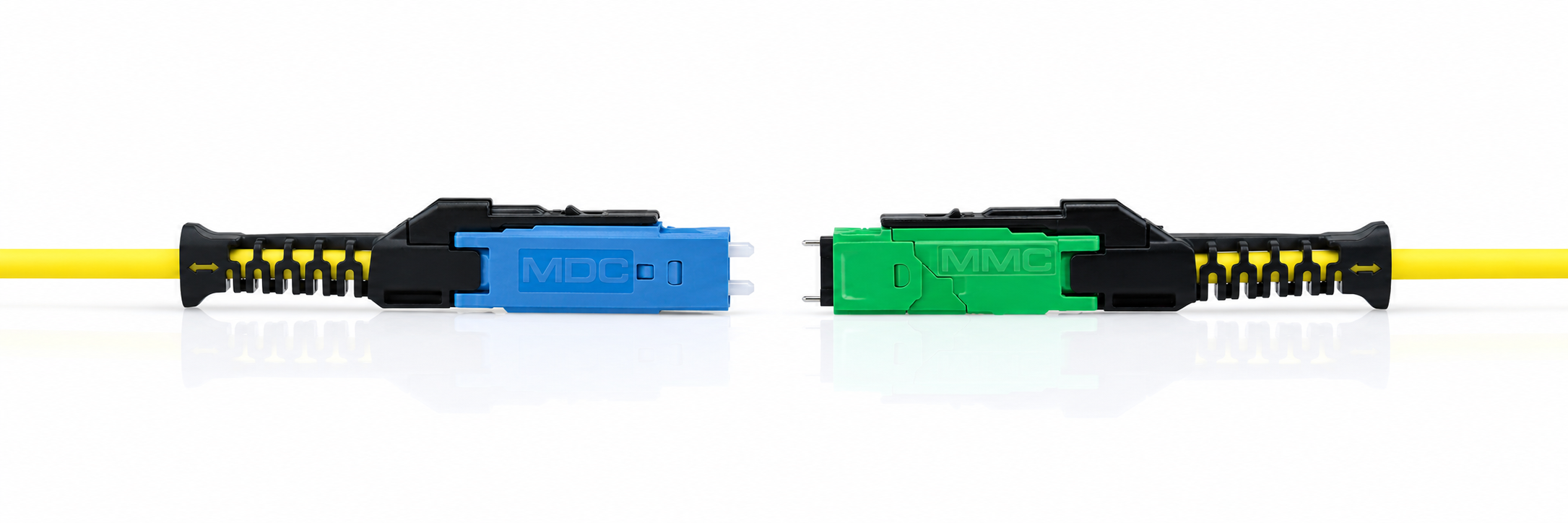
Same principle, two different jobs.
MDC replaces LC for duplex connections. MMC replaces MPO for multi-fiber trunks. Both do it the same way: shrink the connector, keep the port count, triple what fits in a rack unit.
The MDC Connector
Everything the LC connector does, at a third of the size — with a boot mechanism that makes reversing polarity a tool-free, ten-second job.
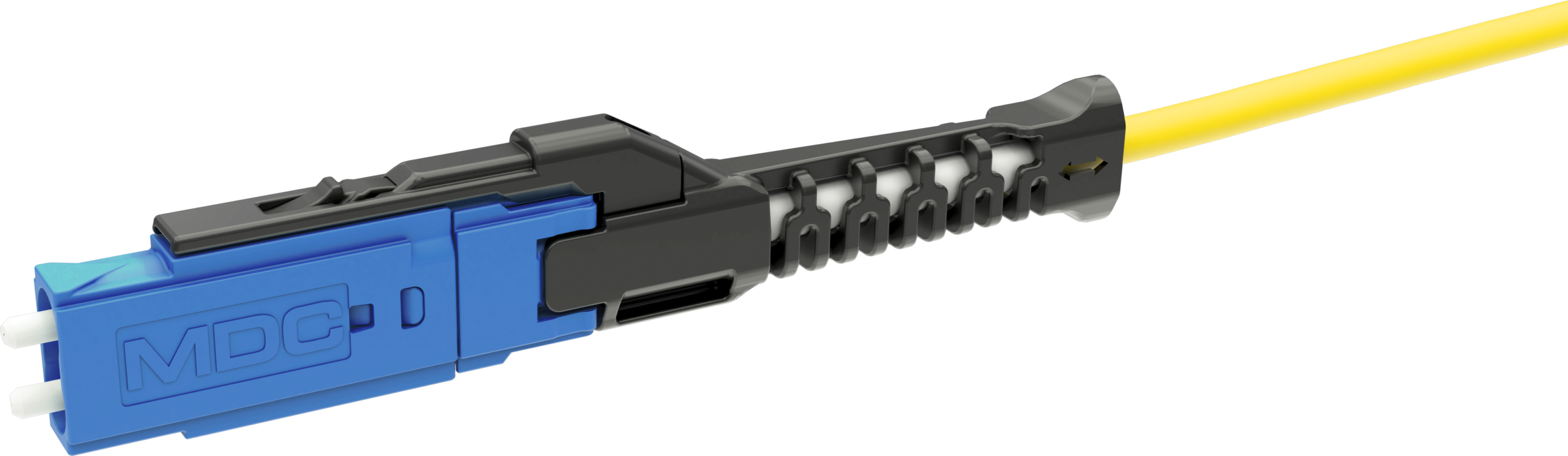
Built on a ferrule you already trust.
The ELiMENT® MDC uses the same 1.25 mm ferrule as the industry-standard LC — for multimode and singlemode cables up to 2 mm OD. The reliability is proven; only the footprint is new.
The DirectConec™ boot gives individual port access even in the densest panels, and reverses polarity with no exposed fibers: pull, rotate 180°, reassemble.
The MDC ecosystem
2, 3 & 4-port adapters
Connect MDC to MDC or MDC Jr. The 2- and 3-port versions fit the same panel cutout as duplex LC — no new chassis needed.
MDC Jr.
A smaller sub-variant for breakout and on-board optic architectures, with the same functionality in less space behind the panel.
QSFP & SFP breakout
4 cables fit a QSFP footprint, 2 fit an SFP footprint — each individually accessible right at the transceiver face.
The MMC Connector
MPO's fiber count, in a fraction of the footprint — built for the switching architectures MPO can no longer keep up with.
A new ferrule, an old alignment standard.
The MMC uses a new TMT ferrule that stays intermateable with the proven MT-16 alignment structure — at less than 25% of its size. That's what lets MMC-16 match MPO-16's fiber count in a connector small enough for co-packaged optics and on-board modules.
Supports singlemode and multimode cables up to 2.5 mm OD, with the same DirectConec™ push-pull access as the MDC.
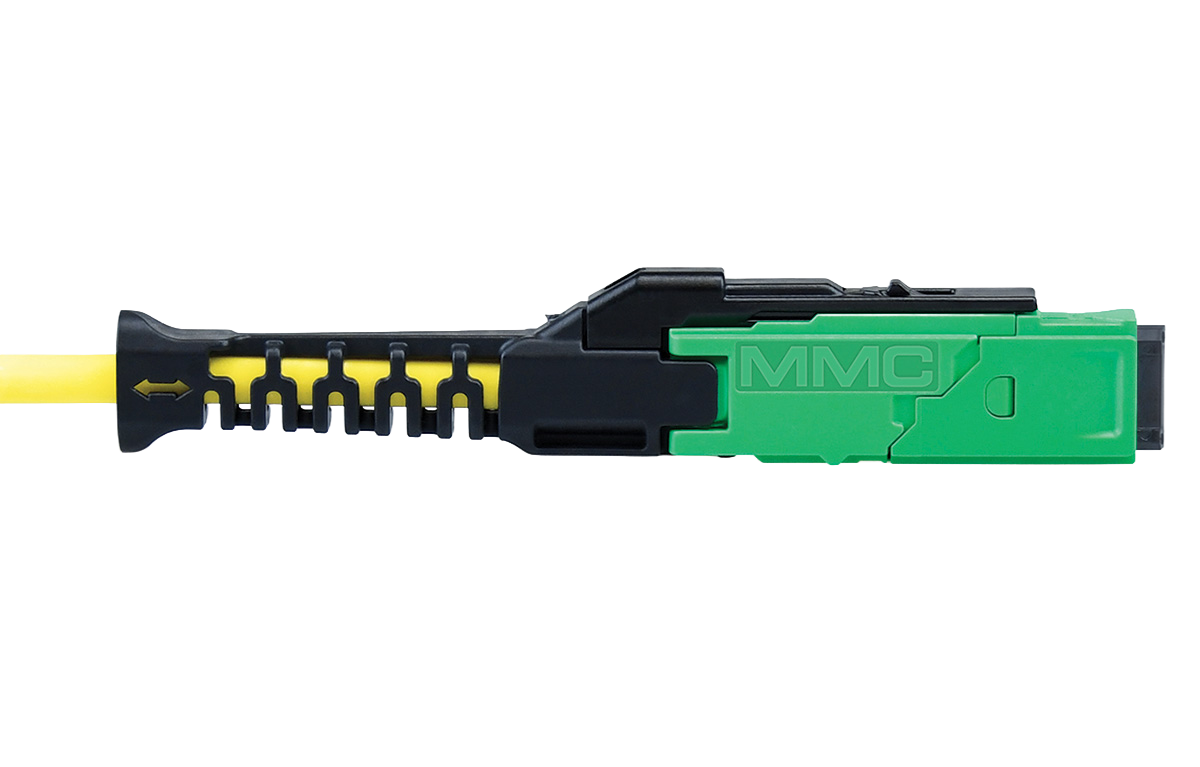
Built at a quarter of the size
The TMT ferrule keeps every mechanical and optical advantage of MT-16 — precision polish, durable repeated mating — while shrinking the connector body dramatically. That's the difference that lets MMC reach where MPO physically cannot fit.
MMC Jr.
Minimizes board space behind module and panel walls — built for transceivers and on-board optics.
Co-packaged optics
Small enough to sit inside the module housings that on-package transceivers require.
51.2T hyperscale switching
Delivers the fiber count 500m-reach hyperscale switching needs, where MPO runs out of room.
MDC vs. MMC, at a glance.
Same design philosophy, different jobs. Use this to pick the right one for your build.
| Specification | MDC | MMC |
|---|---|---|
| Connector type | Duplex (2-fiber) | Multi-fiber (up to 16) |
| Ferrule | 1.25 mm (LC-proven) | TMT / MT-16 aligned |
| Fiber modes | MM, SM, SM APC | MM, SM, SM APC, MM APC |
| Density vs. incumbent | 3× over LC | 3× over MPO |
| Sub-variant | MDC Jr. | MMC Jr. |
| Best for | High-density duplex patching, QSFP/SFP breakout | Co-packaged optics, 51.2T hyperscale switching |
Need MDC or MMC assemblies, built to spec?
Connector type, fiber count, length, polarity, jacket rating — iFiber Optix has built custom fiber assemblies since 2000.