
LC to ST Multimode OM1 Ultra Fiber Cable for Short-Distance, High-Speed Data Transmission
The iFiber Optix LC to ST Multimode OM1 Ultra Fiber Cable delivers seamless connectivity between compact high-density LC interfaces and secure twist-lock ST connectors — bridging modern network equipment and legacy infrastructure in a single, direct-wired assembly over OM1 multimode fiber.
With support for 1 Gbps Ethernet over distances up to 300 meters, this cable is ideal for LANs, data centers, telecom systems, and storage networks where LC and ST connector types must interconnect without adapter couplers or extra patch cord runs.

LC to ST Multimode OM1 Ultra Fiber Cable
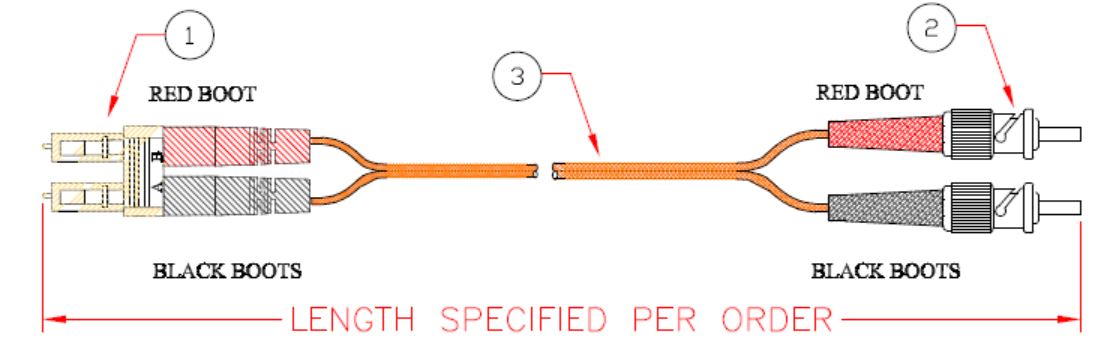
The LC to ST OM1 cable combines two widely used connector types with Corning 62.5/125µm multimode optical fiber — offering reliable performance for short-range communication. The LC connector on End A provides a compact, high-density interface widely used in modern data centers and telecom rooms, while the ST connector on End B delivers a secure bayonet twist-lock connection ideal for legacy networking equipment and systems that have not been migrated to newer connector standards.
This direct cross-cable eliminates the ST-to-LC adapter coupler and second patch cord that would otherwise be required — reducing connection points, insertion loss, and cable management complexity in mixed-connector environments.
Performance Specifications
All iFiber Optix LC-ST OM1 assemblies are manufactured and tested to meet or exceed the following optical and mechanical performance specifications.
| Insertion Loss | 0.3 dB |
| Typical Insertion Loss | 0.2 dB |
| Return Loss | ≥ 20 dB |
| Mating Durability | <0.2 dB change (500 cycles) |
| Temperature Range | -40°C to +85°C |
| End A Connector | LC/PC (Push-Pull Latch) |
| End B Connector | ST/PC (Bayonet Twist-Lock) |
| Fiber Core / Cladding | 62.5 / 125µm |
| Part Number | i1611-H-XX-2J |
| SPC GR-326 Protrusion | +50 / -100 nm |
Key Features
- Direct LC-to-ST Cross-Connection Factory-terminated with LC on End A and ST on End B — eliminating the adapter coupler and second patch cord that would otherwise be required to bridge these two connector types, reducing insertion loss and removing an extra mechanical joint from the channel.
- Corning 62.5/125µm OM1 Fiber Built on Corning optical fiber — the global standard for long-term transmission reliability. The 62.5µm core supports 1 Gbps Ethernet over distances up to 300 meters, making this cable ideal for existing OM1 plant in LANs, data centers, and campus environments.
- Legacy & Modern Interface Compatibility ST connectors are installed in millions of active legacy network ports worldwide. The LC-ST configuration bridges those ST-equipped systems directly to modern LC-port switches, media converters, and patch panels — extending infrastructure life without requiring port-by-port hardware replacement.
- Low Insertion Loss Both LC and ST connectors deliver ≤ 0.3 dB insertion loss (0.2 dB typical) — ensuring strong, stable signal transmission with minimal degradation across the full duplex OM1 channel under all rated operating conditions.
- Optimized for High-Density Environments The LC connector's compact form factor on End A supports high-density panel installations — fitting significantly more connections per rack unit than SC or ST connectors at the switch or patch panel end while the ST end connects securely to existing infrastructure.
- Durable Long-Term Performance Rated for 500+ mating cycles with less than 0.2 dB change in insertion loss across an operating range of -40°C to +85°C — engineered for reliable performance in demanding network environments with frequent patching and varying environmental conditions.
Ideal Applications
LC to ST OM1 cables are deployed wherever modern LC-equipped switches and equipment must connect to ST-terminated legacy cabling infrastructure across a range of short-distance networking environments.
Legacy Infrastructure Upgrades
Connects ST-terminated wall plates, horizontal cabling, and splice enclosures directly to modern LC-port switches and patch panels — deferring full recabling while delivering immediate connectivity improvements.
Data Centers
The compact LC connector enables high-density patching at modern switch and server ports, while the ST connector provides secure twist-lock connections to legacy fiber enclosures and distribution frames still in active use.
Local Area Networks
Connects computers, switches, and routers within office LANs and campus environments where LC-equipped access switches must interface with existing ST-terminated horizontal cabling runs.
Telecom Networks
Used in telecom rooms and networking closets to connect ST-terminated legacy feeder cables to LC-equipped multiplexers, OLTs, and distribution equipment during phased infrastructure migrations.
Storage Area Networks
Provides reliable short-distance connectivity between ST-terminated SAN fabric switches and LC-equipped storage arrays or HBAs — supporting fast, consistent data transfer between storage systems and servers.
Government & Regulated Facilities
RoHS-compliant construction and GSA contract availability make LC-ST OM1 cables a direct-procurement option for government facilities managing mixed LC/ST infrastructure across aging campus and building networks.
How to Configure Your LC-ST OM1 Assembly
Four decisions define your LC-ST OM1 assembly — use this guide to arrive at the right configuration for your deployment.
Confirm Distance & Bandwidth
OM1 supports 1 Gbps up to 300 meters. If your runs exceed this distance or require 10G speeds, consider OM3 or OM4 multimode. For runs over 2km, OS2 singlemode is the appropriate solution. Confirm your transceiver specifications before finalizing fiber type — mismatched fiber grades cause link failures that are difficult to diagnose in the field.
Verify Connector Orientation
Confirm which end of your run uses LC and which uses ST before ordering. LC is End A (compact push-pull); ST is End B (bayonet twist-lock). If both ends use the same connector type, specify LC-LC or ST-ST instead. For existing runs with adapter couplers in place, a direct cross-cable removes the coupler and reduces insertion loss by ~0.3–0.5 dB per removed joint.
Select Length & Jacket
Available in standard lengths from 0.5m to 15m and custom lengths for special routing. PVC (OFNR) for standard equipment rooms and data center environments, plenum (OFNP) for air-handling spaces and above-ceiling runs, LSZH for facilities with halogen restrictions or European compliance requirements.
Network Density Considerations
LC connectors support significantly higher port density than ST at the switch or patch panel end — if you are planning a high-density LC panel and connecting to existing ST horizontal cabling, this cable gives you the density advantage at the panel while preserving the existing plant. If ST density is also a concern, consider a full panel upgrade with ST-LC patch cords and a new LC panel.
Why Choose iFiber Optix?
- Quality Assurance Every LC-ST OM1 assembly is manufactured to meet industry performance standards and tested before shipment — ensuring consistent insertion loss, return loss, and mechanical performance across every cable we produce.
- GSA Contract Holder iFiber Optix holds an active GSA contract, making our fiber assemblies directly available to federal, state, and local government agencies without separate procurement processing.
- Custom Configurations Available Custom cable lengths, jacket types (PVC, plenum, LSZH), and bulk quantities available — manufactured to your exact project specifications for seamless integration into mixed LC/ST OM1 infrastructure.
- TAA & BABA Compliant Options Trade Agreement Act and Buy American Act compliant configurations available for government and regulated procurement — contact us to confirm compliance for your specific project requirements.
Request Information
Ready to spec LC-ST OM1 cables for your next deployment? Our team can help with custom lengths, jacket selection, bulk pricing, and GSA procurement.